Visual experience in the real world rarely arrives as a tidy stack of independent images. An experiment, a journey, or a match can last for hours, while the evidence that changes a judgment may appear only briefly. A model has to notice when an event changes and remember how those changes connect. This motivates my first research thread: organizing semantic boundaries, event anchors, and query-relevant information so that a finite input still retains a coherent account of what happened.
Research
Understanding a world in motion
I want to build multimodal systems that can keep seeing, organizing, and understanding information over real-world time scales. The path starts with event structure in long video, then asks how generation can propose testable hypotheses and how a model can accumulate evidence without losing it as a visual stream continues.
I want models to form an understanding that remains revisable over real-world time scales. These three passages explain why the path begins with long video and leads toward generation and evidence checking.
Generation adds another possibility. A model can propose an event description, a missing state, or a possible future, then return to its observations to look for support and contradiction. These generations are candidates rather than evidence. Their value lies in turning an ambiguous internal state into something that can be inspected. If a candidate cannot be grounded in time, entities, or causal order, it should be revised or rejected.
The system I ultimately want to build should maintain a working account of events while video keeps arriving. It should know what has been confirmed, what remains hypothetical, and when earlier evidence needs to be revisited. An answer is only one output of this process. More important is an event representation that can keep changing with new information while preserving where its evidence came from.
01
Observe
Find structure in continuous visual streams
Treat video as events unfolding in time rather than isolated frames. Semantic boundaries, event anchors, and long-term memory determine what the model actually sees.
EFSWFS-SB
02
Propose
Turn an uncertain reading into inspectable candidates
Generate event descriptions, missing states, or possible futures so an unfinished judgment becomes an intermediate object that can be localized, compared, and falsified.
Generative understandingHypothesis grounding
03
Verify
Let understanding keep changing with evidence
Place each candidate back on the timeline and against the original visual evidence. Keep what is supported, revise conflicts, and update event memory over long horizons.
Evidence tracingStreaming video understanding
Evidence
How the published work supports this path
The papers address event structure, query-aware budgets, and semantic boundaries. They are also the technical starting points for what comes next.
 2026
2026CVPR 2026
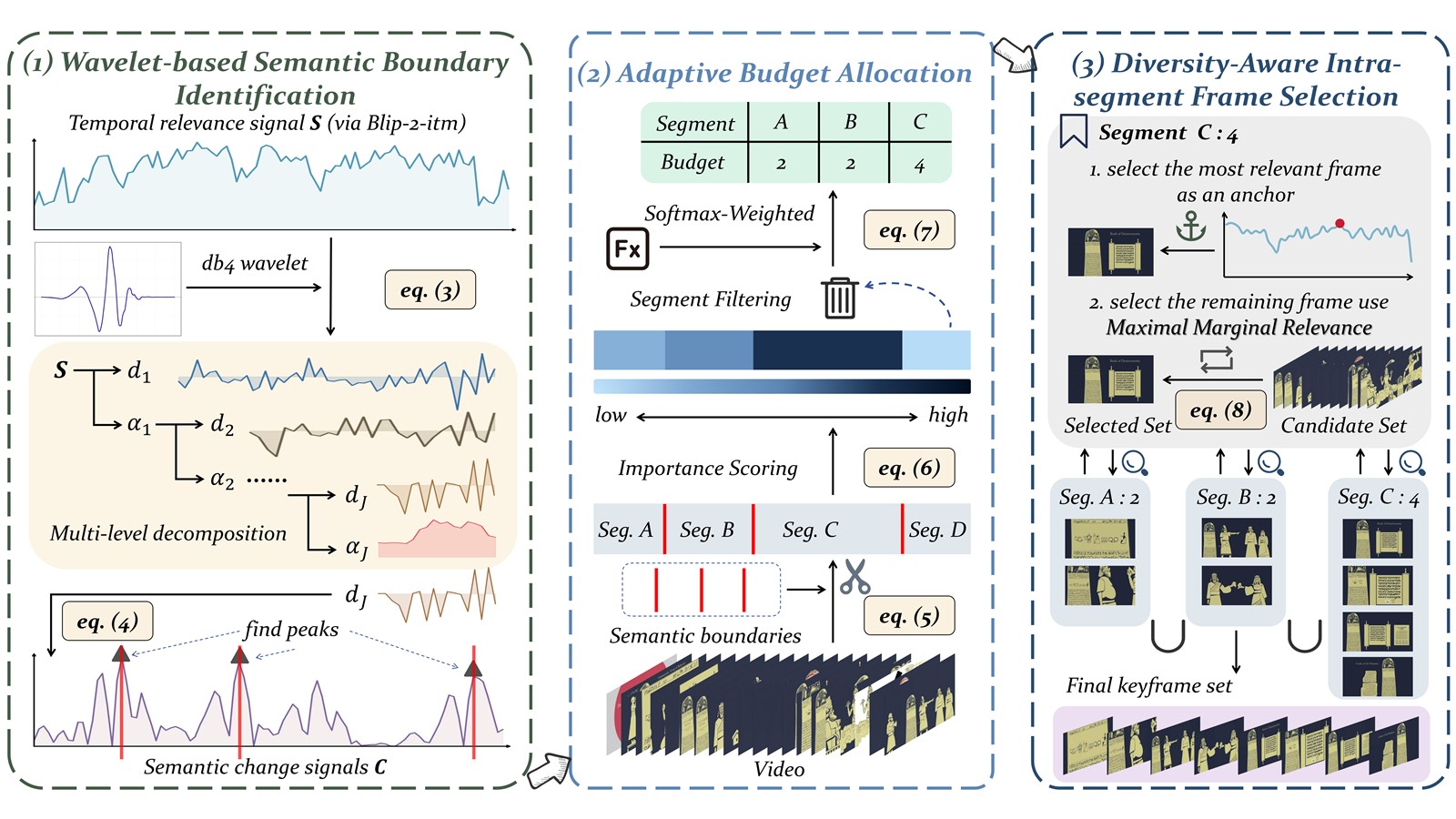
Wavelet-based Frame Selection by Detecting Semantic Boundary for Long Video Understanding
Detects semantic boundaries from a noisy query-frame relevance signal, then allocates frame budgets by segment importance. The training-free method improves VideoMME, MLVU, and LongVideoBench by 5.5, 9.5, and 6.2 points.
 2026
2026AAAI 2026 · Equal contribution
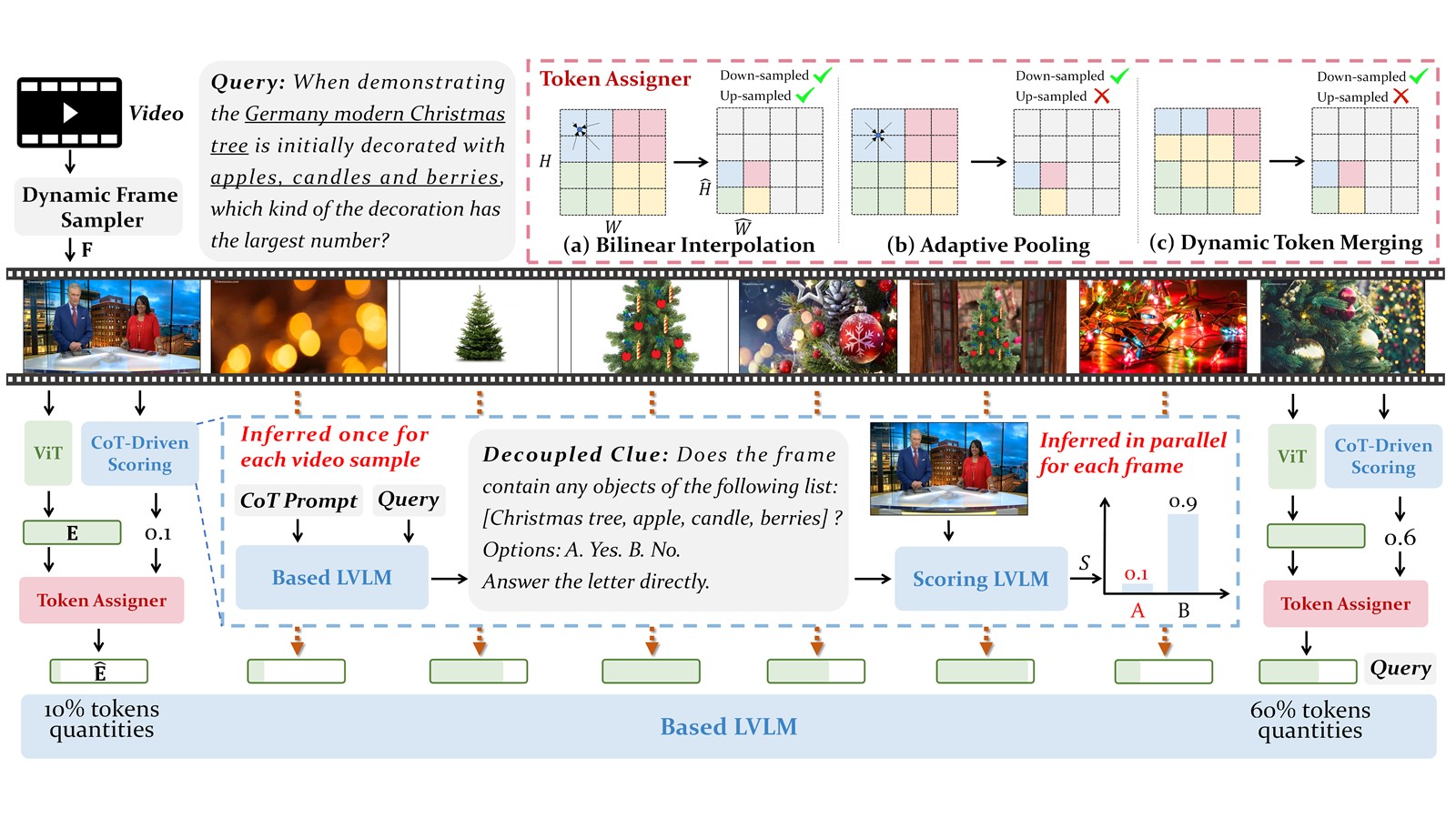
QuoTA: Query-oriented Token Assignment via CoT Query Decouple for Long Video Comprehension
Allocates visual tokens to frames before cross-modal interaction. CoT turns a complex query into scorable clues, improving six video benchmarks by 3.2 points on average under the same token budget.
 2026
2026arXiv preprint · Equal contribution
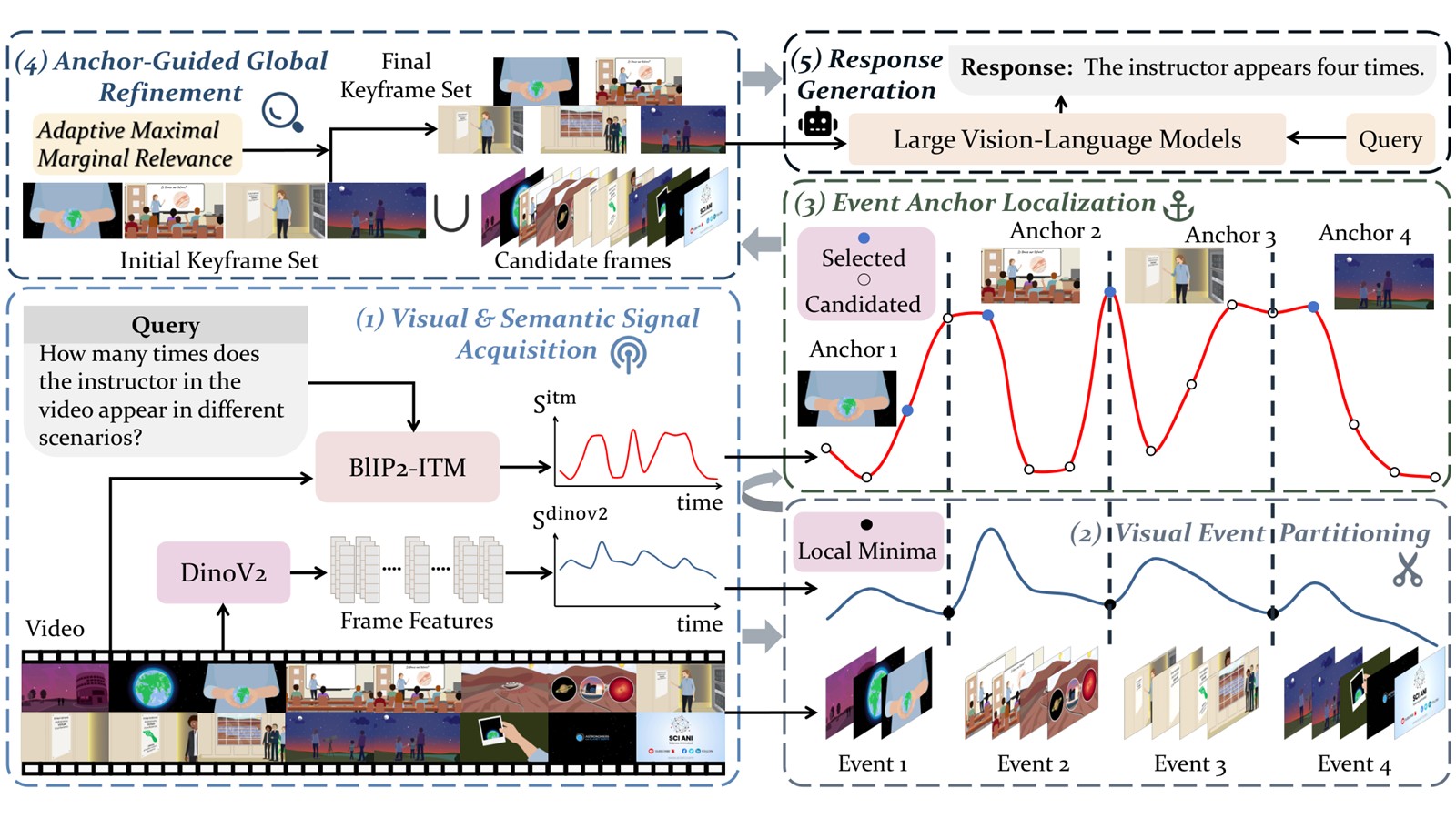
Event-Anchored Frame Selection for Effective Long-Video Understanding
Partitions video into coherent events, localizes a query-relevant anchor in each event, and applies adaptive MMR for global refinement across coverage, relevance, and diversity.
Ongoing
From evidence selection to generation, verification, and sustained understanding
The next projects connect event structure in long video with generative models, then return every candidate explanation to the observations for testing.
How generation can help understanding
Studying how generative objectives, internal features, and candidate hypotheses can expose what a model has not yet understood, then using observations to ground, test, and revise them.
Long-horizon streaming video understanding
Exploring hierarchical memory, event updates, and evidence revisiting so models can sustain long-term understanding under low-latency constraints.